Sustainability Made Simple: Why Nigeria Must Educate Its Children on Turning Waste into Wealth – Deji Orunkoyi
If Nigeria is serious about securing a sustainable future, the conversation must begin where the future itself begins: in our primary and secondary schools. For too long, sustainability has been...

If Nigeria is serious about securing a sustainable future, the conversation must begin where the future itself begins: in our primary and secondary schools.
For too long, sustainability has been presented as an abstract, sophisticated concept reserved for environmental experts, international conferences, policymakers and development organisations. It is often wrapped in technical language that makes it appear distant from the everyday realities of ordinary people. Yet sustainability is neither complicated nor beyond the understanding of a young Nigerian child. It is about how we use what we have, how we manage what we discard, how we protect our environment and, more importantly, how we create economic value from resources that would otherwise become waste.
My perspective is simple: we must demystify sustainability and make it a practical part of our children’s education.
Our children should not merely learn about pollution, climate change, global warming and environmental degradation from textbooks. They should be taught how to become part of the solution. They should understand that the plastic bottle they throw away could become a valuable resource, that discarded materials can be transformed into useful products, and that what society calls waste could become somebody else’s business opportunity.
This is where education must evolve.
From Environmental Awareness to Wealth Creation
At the primary and secondary school levels, sustainability education should move beyond occasional environmental sanitation exercises and theoretical classroom discussions. It should become practical, creative and entrepreneurial.
Imagine a generation of Nigerian pupils who understand recycling, waste sorting, composting, upcycling and the principles of a circular economy before they leave secondary school.
Imagine schools where pupils are encouraged to collect discarded plastic bottles, learn how they can be processed and recycled, explore how organic waste can become compost, and discover how discarded materials can be transformed into furniture, fashion accessories, construction materials and other commercially viable products.
The objective is not simply to teach children how to keep their surroundings clean. It is to help them recognise economic opportunities in environmental challenges.
A child who understands how to transform waste into a marketable product is acquiring more than environmental knowledge. That child is learning entrepreneurship, innovation, problem-solving, resource management and the foundations of wealth creation.
We must begin to raise environmental entrepreneurs, not merely environmentally conscious citizens.
COP31: A Moment of Reflection for Nigeria
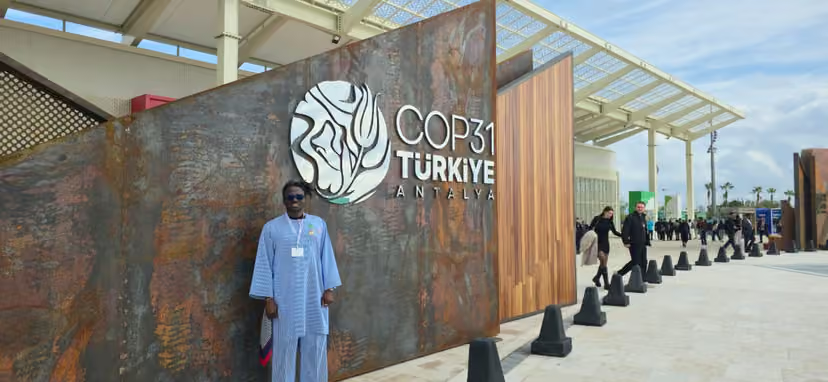
My engagement with several organisations from different parts of the world at COP31 reinforced an important observation: Nigeria still has considerable ground to cover in building a widespread culture of sustainability.
The conversations, innovations and approaches I encountered highlighted how seriously different countries and organisations are integrating sustainability into education, business, technology, manufacturing and community development.
It was a moment of reflection.
We have enormous human capital, entrepreneurial energy and creative ingenuity in Nigeria. However, we must begin to translate these strengths into deliberate investments in environmental innovation and sustainable economic development.
I have always believed in the Nigerian spirit. We may sometimes arrive late to certain global conversations, but history has shown that when Nigerians understand an opportunity, embrace it and commit their creativity to it, we have the capacity to compete and establish our own identity.
Look at the Nigerian music industry. Look at fashion. Look at football and the entertainment industry. These are sectors in which Nigerians have demonstrated an extraordinary ability to learn, innovate, build audiences and create global relevance.
Sustainability should not be an exception.
We must move from being consumers of global sustainability ideas to becoming creators, innovators and owners of sustainable solutions.
Nigeria should not merely participate in the global sustainability conversation. We should develop solutions that other countries can study, adopt and replicate.
The Opportunity in Nigeria’s Waste Economy
One of the biggest misconceptions about waste is that it has no value.
In reality, waste represents an enormous economic opportunity when properly managed. Plastic, paper, metal, glass, textiles and organic materials can all be recovered, processed and returned to productive use.
Nigeria’s growing population, expanding cities and increasing consumption create an urgent need for more efficient waste management systems. But within this challenge lies an opportunity to build businesses, generate employment and stimulate innovation.
Consider the possibilities.
Plastic waste can become recycled packaging, household products and industrial materials. Agricultural waste can be converted into compost, animal feed and bio-based products. Used textiles can be redesigned into fashionable products, while discarded paper and metal can feed recycling industries.
These are not merely environmental interventions. They are potential industries capable of creating jobs, supporting small businesses and attracting investment.
The idea of turning bottles into meals is a compelling illustration of how environmental responsibility can intersect with social impact and economic value. When recyclable materials are exchanged for food or other essential benefits, waste recovery becomes more relatable to ordinary people.
It creates an incentive for participation and demonstrates that environmental action can deliver tangible benefits.
We need more initiatives like this, particularly those that connect environmental protection with livelihoods, community development and poverty reduction.
Why Schools Must Become Sustainability Laboratories
If we want sustainability to become part of Nigeria’s national culture, our schools must become the starting point.
The Federal Ministry of Education, state ministries of education, private school proprietors, environmental agencies, manufacturers and development organisations should work together to introduce practical sustainability programmes into the school curriculum.
This should not become another subject that pupils simply memorise to pass examinations. It should be an experience that encourages experimentation, creativity and commercial thinking.
Schools could establish sustainability clubs, recycling centres, school gardens and innovation competitions. Pupils could be challenged to develop useful products from discarded materials, while businesses could sponsor competitions and support promising ideas.
A secondary school student who develops an innovative recycling solution should have access to mentorship, technical support and opportunities to commercialise that idea.
Similarly, primary school pupils should be introduced to simple lessons about waste separation, water conservation, energy efficiency, tree planting and responsible consumption.
There are already encouraging efforts pointing in this direction. At COP31, Professor Chinwe Obuaku-Igwe, Director-General and Special Envoy of the Governor of Osun State on Climate Change and Renewable Energy, launched her book, Our Planet, Our Responsibility: A Student’s Guide to Climate Change, the Circular Economy, Renewable Energy, and Tree Planting.
The publication provides another opportunity to introduce young people to important environmental issues in a language and format that speaks directly to their educational needs.
More significantly, Bottles2Meal Africa has partnered with Professor Obuaku-Igwe and the Osun State Government to ensure that the book gets into the hands of schoolchildren. This is a welcome example of how government, individuals and social-impact organisations can work together to take sustainability education beyond international conferences and into the classrooms.
I believe this is the kind of practical intervention Nigeria needs. We must encourage more initiatives that make environmental education accessible to children while helping them understand the relationship between responsible consumption, waste management, renewable energy and economic opportunities.
The earlier these values are introduced, the more naturally they become part of everyday life.
We must also equip teachers with the necessary training and practical resources to deliver sustainability education effectively.
Government, Businesses and the Private Sector Must Step Forward
Government cannot do this alone. The private sector has an important role to play.
Manufacturers, recycling companies, financial institutions, technology firms, fashion businesses and corporate organisations should see schools as strategic partners in building the next generation of sustainability innovators.
Companies can support recycling infrastructure, provide learning materials, organise mentorship programmes and create internship opportunities for students interested in environmental innovation.
There is also a significant opportunity for Nigerian entrepreneurs to build businesses around sustainable products and services.
Our fashion industry, for instance, can explore recycled fabrics and responsible production. The construction sector can investigate innovative applications of recycled materials. The hospitality industry can reduce waste through better procurement, packaging and recycling systems.
Sustainability should not be treated as a corporate social responsibility slogan that appears in annual reports. It should become part of how businesses operate, produce, consume and create value.
The Future Belongs to Those Who Understand Sustainability
Ultimately, the conversation about sustainability is a conversation about the future of Nigeria.
We cannot continue to educate children for an economy that is changing rapidly without preparing them for the environmental and economic realities ahead.
The world is increasingly recognising that economic growth and environmental responsibility must go hand in hand. Nigeria must position its young population to participate meaningfully in this emerging global economy.
My vision is to see sustainability become as familiar to a Nigerian child as music, football, fashion and technology. I want our children to grow up understanding that protecting the environment is not just a civic responsibility; it is also an opportunity to innovate, build businesses, create jobs and generate wealth.
We have the creativity. We have the population. We have the entrepreneurial spirit. What we need now is the right education, the right partnerships and the collective determination to act.
The next generation should not inherit a country struggling under the burden of its waste. They should inherit an economy that understands how to turn its waste into wealth.
It is time for Nigeria to own sustainability. Not just to save the environment, but to build an economy in which environmental responsibility and wealth creation go hand in hand.
The future is not something we wait for. It is something we educate, prepare and build for today.